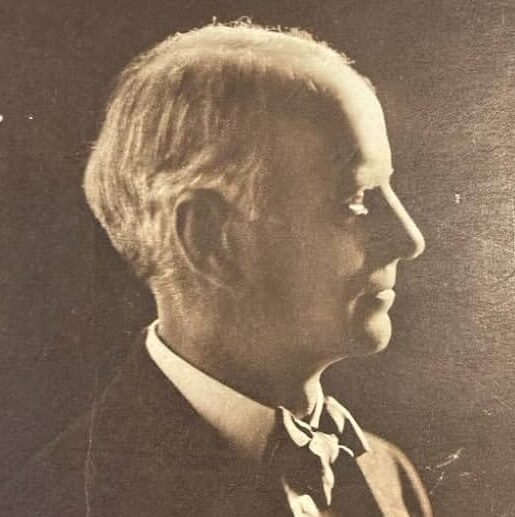
Biography
Philip Boswood Ballard (1865–1950)
Philip Boswood Ballard was a renowned British educator, school inspector, and author of key works in the field of pedagogy. He was head of the Tondu Teacher Training School (1898–1903), inspector in Glamorgan (1903–1905), and at the London County Council (1906–1930). He held leadership positions in institutions such as the Association of Educational Inspectors and Organizers, the Child Guidance Council, and the Child Study Society, promoting a more humane, rational, and child-centered education.
Ballard believed that the purpose of teaching was not merely to transmit knowledge, but to shape minds capable of reasoning. In his writings, he insisted that learning should be progressive, well-structured, and adapted to the student’s abilities.
«So, to put it one way, I rolled up my sleeves for the task. I taught with all my strength. I explained and explained again. I asked questions, I drew on the blackboard. I demonstrated with experiments when I had time… and materials. I did everything (or so I thought) as clear as crystal. And to reinforce and secure the important principles, I dictated some notes. My presentation was very solid; my method, in line with the most approved traditions. And yet, the result was disastrous.
When I tested the students, I found that my teaching had not sunk in. I had forced the pace of teaching, but I had not succeeded in forcing the pace of learning. And I learned a lesson I had already learned before, but that, for some strange reason, one has to learn again and again before remembering it and applying it in practice. The lesson was that teaching is not telling; nor is it explaining; teaching is getting the other person to learn. And if learning does not occur, then the teaching has been null and empty.
Judged by that standard, my teaching of elementary science —despite the sincerity of my efforts— was sadly deficient.
I changed my tactics immediately. I shifted the emphasis from teaching to learning. It’s curious: in science, where I was doing most of the work, the results were poor; but in mathematics, where it was the students who worked the hardest, the results were remarkably good.
Only the student’s work is truly effective; and only that explanation is effective which answers a need felt by the student himself. Explaining without the student first feeling that need is wasting one’s breath.
In mathematics, I always trusted my students. I gave them the answers, assuming they would use them properly. And the facts proved me right.»
— Philip Boswood Ballard, from his memoirs Things I Cannot Forget (1937)
The origin of the Ballard Method
At the age of 33, Ballard had an experience that transformed his way of understanding teaching. That experience did not give birth to the Ballard Method, but it did mark the moment when he became fully aware of its value. Over time, without ever formalizing it in a book, his approach became popular and eventually came to be recognized as the Ballard Method.
This method is based on a clear conviction: the student cannot be a passive recipient, but neither should they be left to their own devices. Learning is not about constant exposition or free discovery, but about creating the right conditions for the brain to activate and seek explanation at the right moment.
The Ballard Method teaches the student to activate the mind before receiving the explanation, to pause before highlighting, to ask themselves “What don’t I understand?” before looking for the answer. Because only then —when thinking has been set in motion— does knowledge find a place to stay.
Pedagogical legacy
Although his name is not widely known today, Philip Boswood Ballard left a significant impact on 20th-century British education. His advocacy for reflective, structured, and student-centered teaching remains relevant for those who believe in education with purpose and depth.
Learn to study with the Ballard Method
If you want to learn how to study using the Ballard Method —understanding instead of memorizing, progressing with logic, and studying with purpose— we offer you the course taught by Ferran Ballard, which teaches you step by step how to apply this method based on scientific evidence.

"It’s not enough for a child to get the right answer; we must know how they got it and why."